Identity Governance
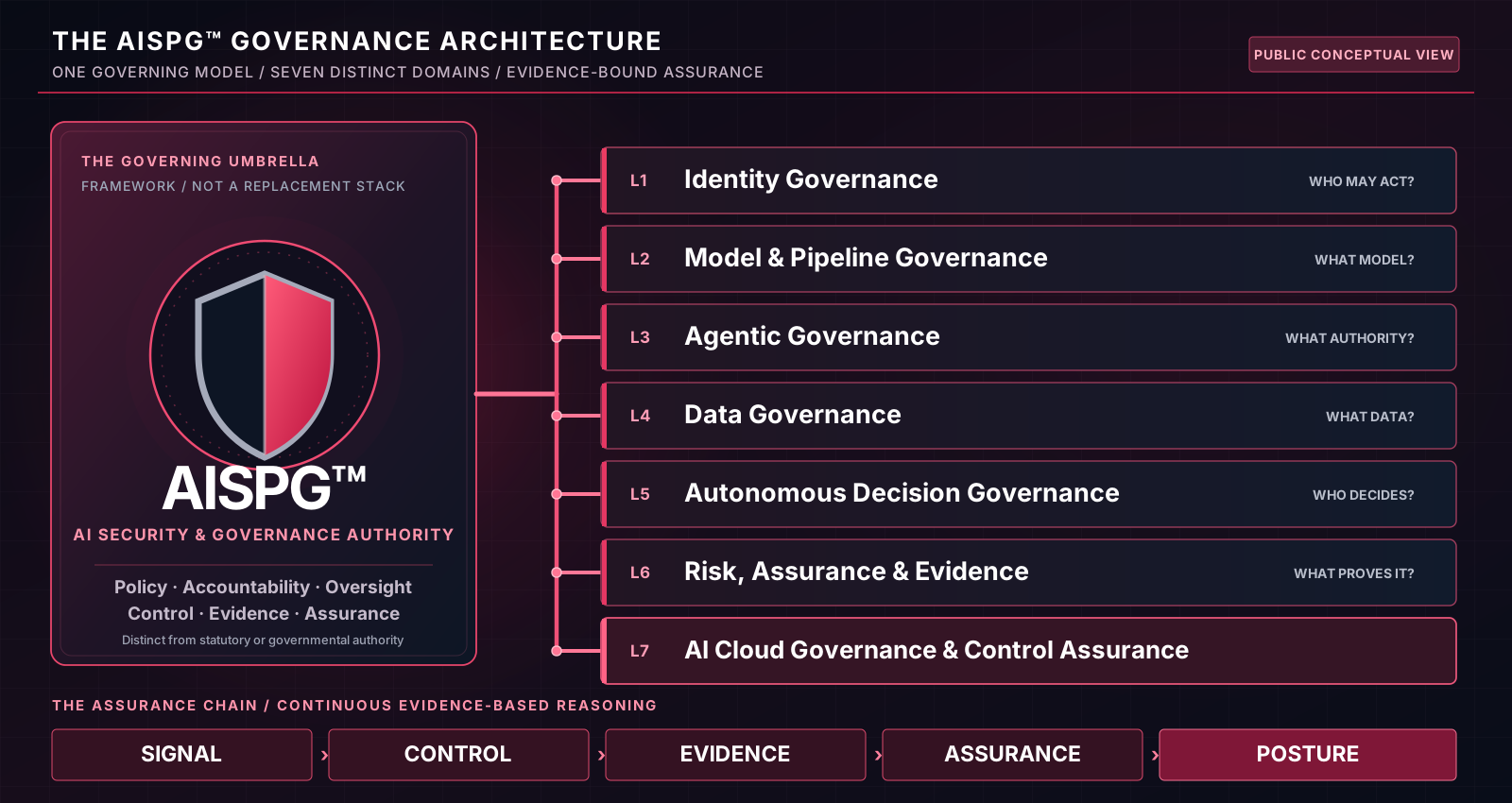
Human and non-human identities, effective authority, access boundaries, purpose and accountable action.
Architecture / Seven governing domains
AISPG™ connects accountable governance responsibilities to diverse AI surfaces and their dependencies. Its seven domains organize the work; its 60-control catalog provides a structured foundation for assessment—not an assertion that every control is production-qualified.
THE GOVERNANCE FABRIC / INTERACTIVE PUBLIC VIEW
Select a governance domain to understand the accountable question it addresses. This is the public conceptual view; it is not the confidential control specification.
Who or what has effective authority to act—and under whose accountability?
Human and non-human identities, access boundaries, delegated authority and accountable AI actions across enterprise systems.
CANONICAL DOMAINS
Human and non-human identities, effective authority, access boundaries, purpose and accountable action.
Model provenance, lineage, approved purpose, version movement, evaluation and promotion decisions.
Agent permissions, tool authority, delegated actions, runtime boundaries and accountable oversight.
Classification, permitted data use, lineage, sensitive handling and output obligations.
Material decision rights, human oversight, explainability obligations and controlled escalation.
Risk interpretation, evidence integrity, validation, exceptions, assurance and confidence.
Cloud-hosted AI and cross-provider policy applicability, control validation and evidence-bound posture.
CONTROL ARCHITECTURE
The framework catalog organizes sixty identifiers: five each for L1–L6 and thirty in L7. Exact implementation state is separate from the doctrine.
Control applicability, evidence quality, assessment method, owner approval, failure conditions, exceptions and revalidation determine whether an actual control conclusion is warranted. A catalog entry is a specification; it is not a production certificate.
| Domain family | Identifiers |
|---|---|
| Identity / Model / Agentic / Data / Decision / Risk-Evidence | 5 each |
| AI Cloud Governance & Control Assurance | 30 |
| Canonical AISPG total | 60 |
THE IMPORTANT DISTINCTION
The entities and actions under obligation, with version, purpose, effective authority and dependencies.
Systems holding authoritative source records, context, events and enforcement capabilities.
The organizing framework for control obligation, evidence evaluation, accountable assurance and posture.
THE NEXT CONVERSATION
Follow the Assurance Chain to see how observations become accountable governance conclusions.
EXPLORE THE NEXT LEVEL
Request approved governance material, a strategic dossier or a scoped architectural discussion.
Enter the Documentation Center ↗